
9 minute read
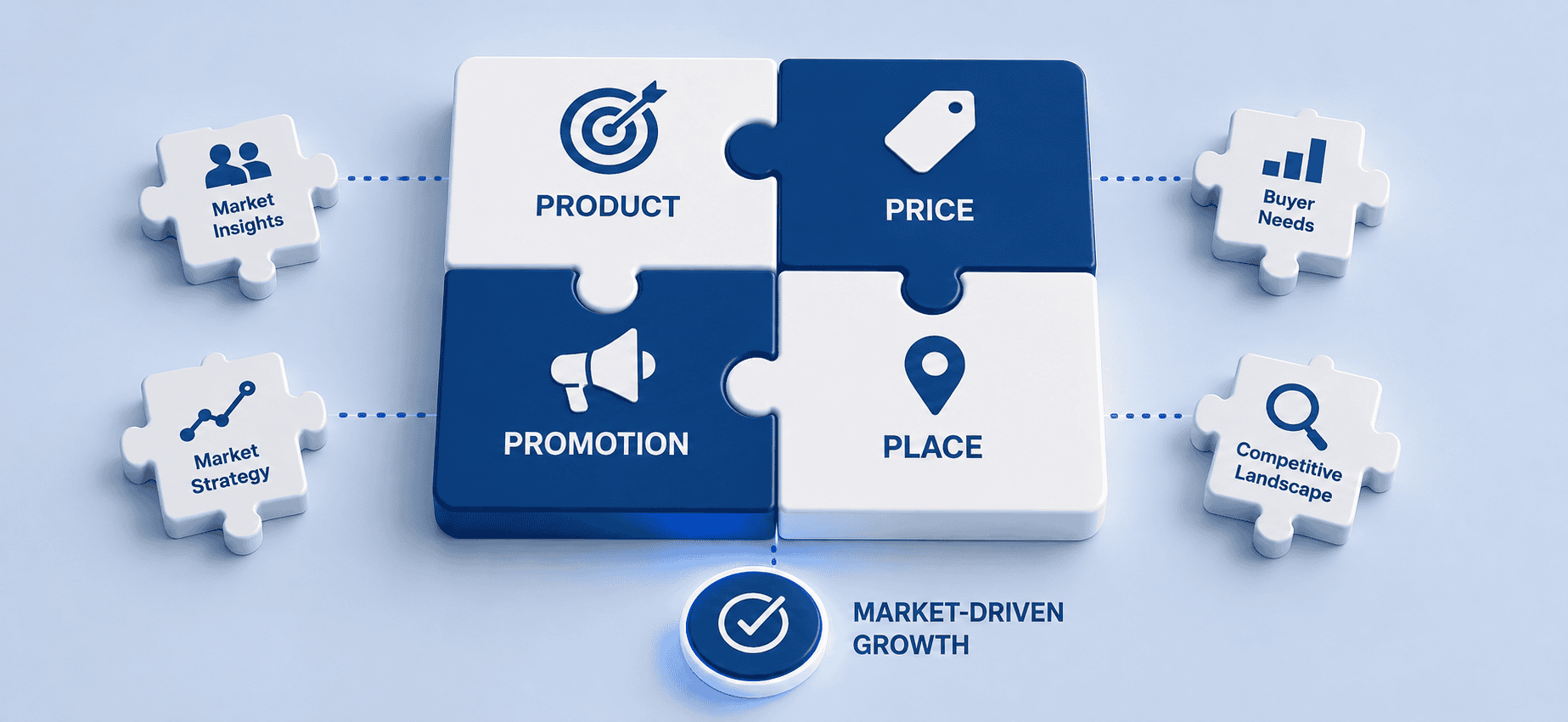
The Four Ps, Product, Price, Place and Promotion, have helped marketers organize fundamental marketing decisions for more than six decades. For product marketing professionals, a market-driven approach adds an important consideration: How can market knowledge help us make better decisions across each of the Four Ps?
The Four P model grew out of the broader concept of the marketing mix. In 1960, marketing professor E. Jerome McCarthy organized the mix into these four categories in his book Basic Marketing: A Managerial Approach. Philip Kotler later helped popularize the Four Ps, and the model became a familiar part of modern marketing practice. Today, the decisions represented by the Four Ps remain part of the work product marketing professionals navigate as they bring products to market.
The questions behind the Four Ps remain relevant to product marketers. What are we bringing to market? What will buyers pay? How will they buy? How should we communicate value?
Getting answers to these questions is more complicated than ever. However, a market-driven approach will help answer them by using knowledge about market problems, buyers, and buying behavior rather than internal assumptions alone
Before the Four Ps: Start With Market Knowledge
Being market-driven means developing a clear understanding of the market before deciding how to respond to it. That requires getting outside the organization and learning directly from buyers, users, and the broader market.
The goal isn’t simply to collect customer requests. Product teams need to understand the problems people experience, which segments share those problems, and what evidence indicates that a problem represents a meaningful opportunity.
Several questions can help build that understanding:
- Is the problem urgent enough that people want to solve it?
- Is it pervasive across a meaningful market segment?
- Are buyers willing to pay to solve it?
- Who experiences the problem, and who influences the purchase decision?
- How do buyers evaluate and purchase solutions?
This knowledge provides context for decisions about products, pricing, go-to-market strategies, and messaging. It can also give product, marketing, sales, and other teams a shared understanding of the market they’re trying to serve.
With that foundation established, product marketers can look at the Four Ps through a market-driven lens.
How Do the Four Ps Change With a Market-Driven Perspective?
The Four Ps don’t need to change. What changes is the information used to make the decisions associated with them.
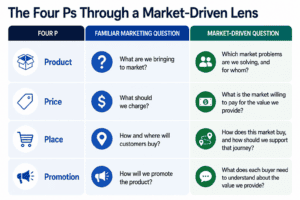
This perspective doesn’t replace the Four Ps. It uses market evidence to develop better answers to the questions they raise.
Product in the Four Ps: Start With Market Problems
It’s easy for a conversation about Product to become a conversation about features and capabilities. A market-driven approach shifts attention from the product itself to the market problems it is intended to solve.
Start by understanding the problems in the market and the segments experiencing them. Then consider the evidence that those problems represent meaningful opportunities. Urgency, pervasiveness and willingness to pay can help teams evaluate whether a problem is worth pursuing.
Not every market problem represents an opportunity, and not every opportunity is right for every organization. Distinctive competencies also matter. Understanding what an organization does uniquely well provides additional context for evaluating where it can deliver meaningful value.
For product marketers, that market understanding becomes especially important in positioning. Effective positioning articulates a product’s unique value around market problems, with positioning tailored to specific personas.
A market-driven view of Product therefore considers:
- The market problem being solved
- The segments experiencing that problem
- Evidence that the problem represents a meaningful opportunity
- The value the organization can uniquely deliver
- How that value should be positioned for relevant personas
This gives product marketers a market-based foundation for communicating why the product matters rather than relying primarily on a list of what it does.
Price in the Four Ps: Connect Pricing to Market Value
Price can easily become an internally focused calculation. Costs, margins, and competitor pricing are all important inputs, but none tells the entire story of what a market is willing to pay.
A market-driven perspective brings customer value into the pricing conversation. Willingness to pay provides important evidence about value relative to market differentiation. Price sensitivity, buyer behavior, and market segment add further context to what buyers may be willing to pay. Different segments can value an offering differently, even when they’re considering the same product.
A market-driven pricing conversation can consider:
Willingness to pay
- Price sensitivity and buyer behavior
- Differences among market segments
- Competitive and market conditions
- Costs and their appropriate role in pricing
- Product portfolios, packaging and bundling
- Broader corporate strategy
Costs and competitors still matter. The difference is that neither should be expected to explain customer value on its own.
For product marketers, understanding the market can provide important context for pricing decisions by connecting differentiation, buyer behavior and perceived value. The question becomes more than “What should we charge?” It also becomes “What is this worth to this market?”
Place in the Four Ps: Understand How Buyers Buy
Traditionally, Place addresses how a product reaches the customer. For today’s product marketing professional, decisions associated with Place can also benefit from understanding channels, go-to-market strategy, and how buyers move through a purchase decision. You can see how complicated the idea of Place has become.
That makes buyer knowledge particularly important. Different buyers can enter and move through the buyer’s journey differently. Influencers may need different information than target buyers, and different market segments may evaluate products in different ways. Understanding those differences gives product marketers better context for determining how and where to engage buyers.
That knowledge can also help teams align the selling process with how the market buys. Sales teams and other channels need tools, training, and market knowledge that reflect how buyers evaluate and purchase products.
For product marketers, thinking about Place can therefore include questions such as:
- Who participates in the buying decision?
- How do buyers move through their journey?
- What do they need at different stages?
- Which channels support the way this market buys?
- How can sales tools and enablement support that process?
Place isn’t synonymous with the buyer’s journey. However, understanding how the market buys provides valuable context for deciding how an organization reaches, engages, and supports buyers.
Promotion in the Four Ps: Turn Market Knowledge Into Messaging
Promotion is often the most visible of the Four Ps. Campaigns, content, emails, events, and sales collateral are tangible outputs of marketing work, but their effectiveness depends on the market knowledge behind them.
Rather than beginning with an asset, a market-driven approach grounds positioning in market problems. Product marketers can then use their understanding of personas and the buyer’s journey to develop relevant messaging and marketing programs.
Several connected elements contribute to that work:
Market problems | Positioning | Personas | Messaging | Marketing programs
Market problems establish the context for why a solution matters. Positioning articulates the product’s unique value around those problems. Persona knowledge helps product marketers understand which aspects of that value matter to particular audiences, while messaging communicates that value in ways relevant to those buyers.
The buyer’s journey adds another layer of context. A buyer who is beginning to understand a problem may need something different from a buyer actively evaluating alternatives. Marketing programs can account for those differences rather than delivering the same message to everyone at every stage.
This helps product marketers avoid a familiar trap: trying to communicate everything a product does to everyone who might buy it.
Effective promotion isn’t simply about producing more marketing assets. It’s about using market and buyer knowledge to communicate relevant value.
What Does a Market-Driven Approach Mean for Product Marketers?
For product marketers, a market-driven approach means using knowledge about market problems, buyers and buying behavior to inform decisions about positioning, pricing, go-to-market strategy, messaging and measurement.
That perspective starts outside the organization. Market knowledge provides context for the choices product marketers make and the recommendations they bring to cross-functional teams.
Being market-driven doesn’t mean responding to every customer request or allowing an individual buyer to determine strategy. Individual feedback can be valuable, but teams need enough market evidence to distinguish broader problems and opportunities from isolated requests.
This outside-in perspective also connects decisions that can otherwise become siloed. Product, Price, Place and Promotion may represent different areas of marketing, but each can benefit from the same underlying understanding of the market.
Measure What Matters Across Product Marketing
Market-driven work doesn’t end when a campaign launches or a product reaches the market. Product marketers also need to determine whether their strategies are producing the intended outcomes.
That begins with defining success. Marketing programs may support goals related to awareness, perception, acquisition, retention, or revenue. Those goals should connect to appropriate key performance indicators so teams can evaluate effectiveness rather than treating activity as evidence of impact.
Depending on the objective, measurement may include metrics such as customer acquisition cost, customer lifetime value, and the relationship between the two. Product launches likewise benefit from clearly defined goals and indicators that allow teams to evaluate progress and results.
The metrics themselves aren’t the strategy. Their purpose is to help determine whether the work is producing the intended business outcomes and provide additional evidence for future decisions.
That’s an important distinction for product marketers. Doing more marketing isn’t necessarily the same as creating more impact.
How Do the Four Ps Fit Into a Market-Driven Product Marketing Strategy?
The Four Ps provide a familiar way to organize four fundamental areas of marketing decision-making:
- Product: What are we bringing to market?
- Price: What will buyers pay?
- Place: How will buyers access and buy it?
- Promotion: How will we communicate its value?
A market-driven perspective adds the evidence behind those decisions. What problems exist in the market? Who experiences them? How do buyers behave? What do they value? What does the available market evidence tell us?
The relationship can be summarized simply:
Market problems and buyer understanding → informed Product, Price, Place and Promotion decisions → measurable business outcomes
For product marketing professionals, that’s where a longstanding marketing model and a market-driven perspective can work well together. The Four Ps organize important questions. Market knowledge helps product marketers develop better-informed answers.
Frequently Asked Questions About the Four Ps and Market-Driven Product Marketing
The following are commonly asked questions about the four Ps of marketing and
What are the Four Ps of marketing?
The Four Ps of marketing are Product, Price, Place and Promotion. E. Jerome McCarthy organized the marketing mix into these four categories in his 1960 book Basic Marketing: A Managerial Approach and Philip Kotler later helped popularize the model. The Four Ps provide a way to organize fundamental decisions about what is offered, what it costs, how it reaches customers and how its value is communicated.
Are the Four Ps part of the Pragmatic Framework?
No. The Four Ps are a longstanding marketing model and aren’t part of the Pragmatic Framework. In this article, they provide a familiar lens for exploring how market knowledge can inform product marketing decisions.
Are the Four Ps still relevant to product marketing?
The decisions represented by the Four Ps remain relevant to product marketing. Product marketers need to understand the value being brought to market, pricing, how buyers purchase and how value should be communicated.
A market-driven perspective adds context to those decisions by considering market problems, buyer insights and buying behavior.
How does a market-driven approach relate to the Four Ps?
A market-driven approach provides market context for decisions involving Product, Price, Place and Promotion. Understanding market problems, segments, buyers and buying behavior can help teams make more informed decisions across each of the four areas.
The Four Ps provide the categories. Market knowledge provides evidence that can help inform the decisions within them.
Where does positioning fit within the Four Ps?
Positioning doesn’t need to be forced into a single P. Positioning articulates a product’s unique value around market problems and can be tailored for specific personas.
That positioning can inform how a product’s value is understood, how it is differentiated and how messages are developed for different audiences. As a result, positioning can influence multiple product marketing decisions rather than functioning only as a form of Promotion.