
5 minute read
Pragmatic Institute experts share practical insights on building go-to-market strategies that align product, marketing, and sales around real customer needs. Learn how market-driven teams use clear positioning and AI thoughtfully to improve execution and results.
Most go-to-market strategies don’t fail because of a lack of effort; they fail because the strategy was never clear from the start. A strong GTM strategy doesn’t add complexity, it reduces it by forcing alignment on three critical questions: What problem are we solving? Who actually cares? And why us?
When these answers are assumed rather than validated, messaging misses the mark and sales conversations stall, regardless of how much activity you generate.
In this article, we’ll break down what teams most often get wrong about go-to-market strategy, what needs to be in place before execution begins, and how to build a practical, market-driven approach, with a clear look at where AI can help and where it can’t.
What Most Teams Get Wrong About Go-to-Market Strategy
Most product teams don’t struggle with go-to-market because they lack activity, but because they misunderstand what go-to-market actually is. Instead of treating it as a strategic process, they treat it as something that happens near the end of product development.
By the time GTM “starts,” the product is already built, assumptions are locked in, and the team is left trying to package and promote decisions that were never fully validated in the market.
This is why so many product launches feel rushed or disconnected. Messaging gets pulled together late. Sales is brought in after key decisions have already been made. Marketing is expected to generate demand for something that hasn’t been clearly positioned. The issue isn’t execution, it’s timing and ownership.
As Steve Gaylor, Pragmatic Instructor and product leader, points out, many teams approach a product launch as a project, focused on tasks and timelines, when it should be treated as a strategic effort tied to business outcomes. When that shift doesn’t happen, teams default to activity instead of alignment.
In practice, this shows up in a few predictable ways:
- Go-to-market planning starts too late to influence product decisions
- Teams optimize for hitting deadlines instead of achieving outcomes
- Messaging reflects internal assumptions rather than market reality
Fixing this doesn’t require more process. It requires starting earlier and grounding decisions in real market understanding. Learn more about why go-to-market strategies fail in this article.
What a Go-to-Market Strategy Actually Needs to Do
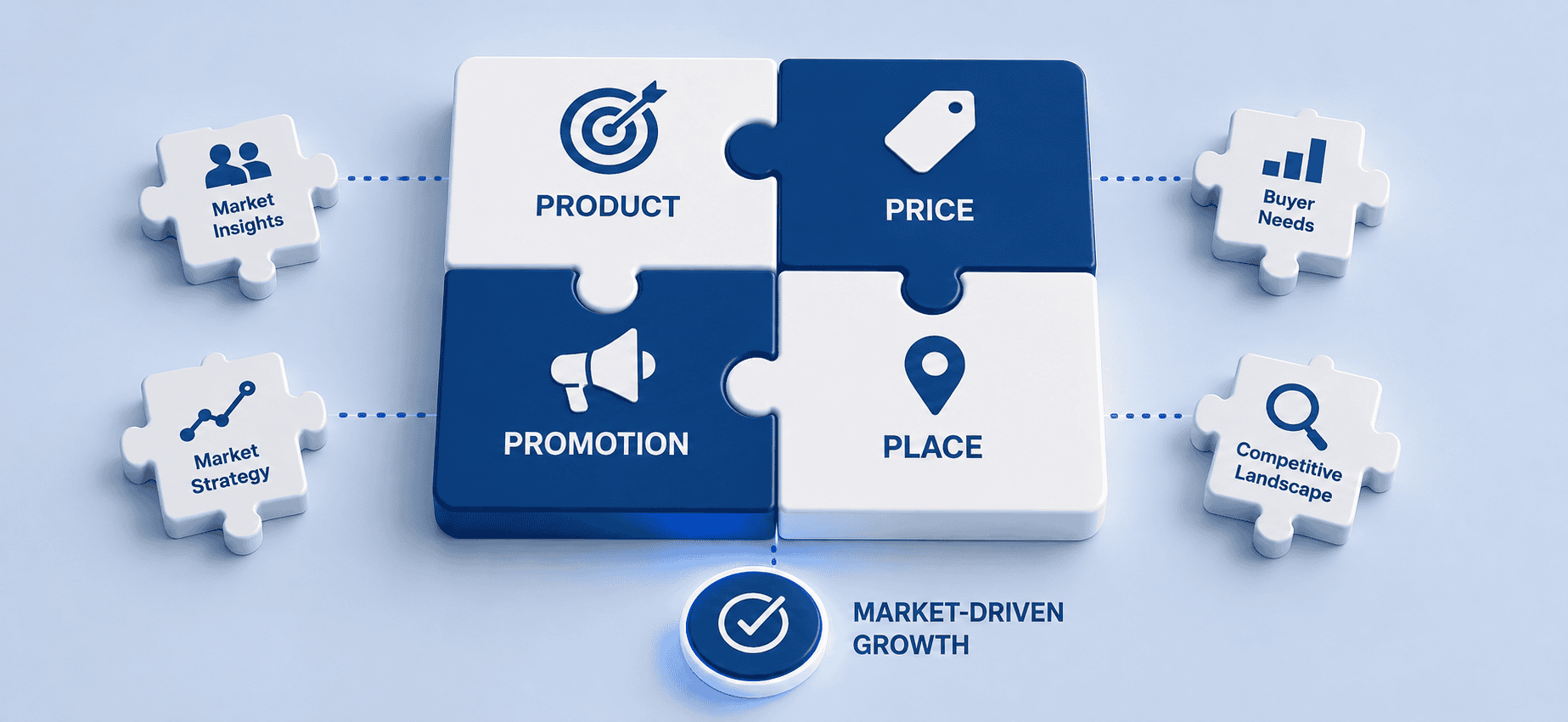
A go-to-market strategy is often described as a plan for launching a product. That definition is technically correct, but it’s not particularly useful. A stronger way to think about it is this: a go-to-market strategy connects your product to a real market problem in a way that drives measurable business results.
That connection only works when a few things are clear and aligned.
- The product team needs to understand the problem deeply
- They need to know who experiences the problem,
- They need to be able to explain why their solution is meaningfully different
When those pieces are in place, go-to-market starts to feel straightforward. Customers recognize the problem, messaging resonates, and sales conversations move forward with less friction.
When they’re not in place, product teams tend to compensate with more effort. This comes in the form of more campaigns, more content, and more outreach. All of these activities generate a feeling of being busy, but none improve results.
What Should Be Clear Before You Build a GTM Strategy
Before you start planning campaigns or outlining launch activities, the most important work is making sure the foundation is solid. This is where many product teams rush, and it’s where most downstream problems originate.
Start With the Problem
Everything starts with the problem. Not a broad category or a feature-driven description, but a clear understanding of what’s happening in the market and why it matters to the buyer. If this isn’t well defined, messaging becomes generic and difficult to connect with.
Understand the Buyer
From there, the focus shifts to the target persona. This goes beyond identifying a role or title. Teams need to understand how buyers think, what they prioritize, and how they make decisions. Without that context, even well-crafted messaging can miss the mark.
Define the Value Clearly
Clarity on value comes next. This is where many teams struggle. If you can’t clearly articulate what’s in it for the buyer, why they should care, your positioning won’t hold up in real conversations.
Terry Sadowski, Pragmatic Instructor and product leader with extensive experience in this area, reinforces this point, “When teams truly understand the problem, the buyer, and the value, everything else, from messaging to sales conversations, becomes easier and more consistent.”
Prioritize and Differentiate
Finally, teams need to understand the competitive landscape and make clear prioritization decisions. Buyers always have alternatives, and strong strategies reflect both differentiation and focus. Trying to address everything at once usually leads to diluted messaging and weaker results.
This often shows up when teams try to target every possible segment with the same message. A product built for enterprise IT leaders, mid-market operations teams, and technical end users rarely resonates with all of them using a single positioning strategy. The result is messaging that becomes too broad to feel relevant to anyone.
The same issue happens when teams try to emphasize every feature or use case equally. Instead of creating clarity, they create noise.
Strong go-to-market strategies prioritize:
- The most important buyer problems
- The highest-value personas or segments
- The outcomes that matter most to those buyers
That focus creates messaging that is clearer, more relevant, and easier for both marketing and sales to execute consistently.
How to Build a Go-to-Market Strategy in Practice
Once the foundation is in place, building a go-to-market strategy becomes less about following a rigid set of steps and more about connecting decisions in a logical way.
It begins with validating what you think you know about the market. Customer interviews, win/loss analysis, and real-world feedback help confirm whether the problem is real and how buyers actually describe it. This step is often skipped or rushed, but it’s one of the most important.
From there, teams define where to focus. Not every segment or use case deserves equal attention. Strong GTM strategies prioritize the areas with the highest impact and the clearest fit.
Positioning and messaging build directly on that foundation. Instead of trying to describe everything the product can do, the goal is to clearly communicate:
- Who the product is for
- What problem it solves
- Why it’s different in a way that matters
This is also where alignment across product, marketing, and sales becomes critical. When teams are aligned, they’re not just sharing information; they’re reinforcing the same story in every interaction.
Defining GTM Success
Defining success is another step that often gets overlooked or handled too loosely. Too often, teams define launch success in vague terms like “increase awareness” or “drive adoption.” While those goals sound reasonable, they’re difficult to operationalize because no one is aligned on what success actually looks like.
A more effective approach is to define success in concrete terms, which Steve describes as a combination of metrics, amounts, and timeframes. This creates a clear finish line and ensures that the team is working toward outcomes, not just activity.
Clear goals force clarity across the organization. Instead of simply saying you want more adoption, define:
- What metric matters most
- What level of improvement you’re targeting
- When you expect to achieve it
For example:
- Increase trial-to-paid conversion by 15% within two quarters
- Generate $3M in qualified pipeline within six months
- Reach 25% adoption across existing enterprise accounts by year-end
This approach does more than improve reporting. It influences decision-making throughout the entire go-to-market process. Teams can prioritize more effectively, align around the same outcomes, and identify earlier when something isn’t working.
It also helps prevent one of the most common GTM problems: confusing activity with progress. Launching campaigns, creating content, or running enablement sessions may indicate effort, but without clearly defined outcomes, it’s difficult to know whether those activities are actually moving the business forward.
How Product, Marketing, and Sales Actually Align
Alignment is one of the most discussed challenges in go-to-market, and one of the least understood. It’s often treated as a coordination problem, solved through meetings or communication tools. In reality, alignment is a clarity problem.
When alignment is strong, it’s because teams share a common understanding of a few critical elements:
- The problem being solved
- The target persona
- The value being delivered
- The goal they’re trying to achieve
In those situations, alignment doesn’t require constant effort. It happens naturally because everyone is working from the same foundation.
A practical way to build this alignment is to start with the goal and work backward. Define what success looks like, then ask each team what they need in order to achieve it. This approach creates ownership within each function and ensures that everyone is contributing to the same outcome.
When alignment is missing, it usually shows up quickly in inconsistent messaging, fragmented execution, and missed opportunities.
The Most Common Go-to-Market Mistakes
Most go-to-market challenges aren’t unique. They tend to follow a consistent set of patterns. One of the most common is treating GTM like a checklist. Teams rely on templates or predefined steps instead of building a strategy based on their specific market and goals.
Another issue is lack of ownership. When go-to-market is treated as a shared responsibility without clear accountability, important work falls through the cracks.
Other common patterns include:
- Weak or unclear problem definition
- Limited investment in sales enablement
- Not involving key stakeholders early in the process
- Focusing on tactics without a clear strategic foundation
These issues don’t always cause immediate failure, but they create friction that compounds over time.
How to Tell if Your Go-to-Market Strategy Is Working
You don’t need to rely on intuition to know whether your GTM strategy is working. The signals are usually clear. When things are working, buyers understand the value quickly. Sales conversations are consistent and productive. Pipeline and conversion rates improve because the message resonates.
When things aren’t working, teams often try to fix the problem by increasing activity. More campaigns, more outreach, more content. But the underlying issues, unclear positioning, weak alignment, or poor problem definition, remain.
A common misconception is that a successful launch is one where everything was delivered on time. In reality, hitting deadlines doesn’t mean you achieved meaningful results. Success is defined by outcomes, not activity.
If You Could Improve Only One Thing
If a team could focus on just one area, it should be clarity around the problem and the value to the buyer.
When that’s strong, it has a ripple effect across everything else. Messaging becomes clearer, sales conversations become more effective, and campaigns perform better because they’re grounded in something real.
The second area to focus on is sales enablement. Even the best strategy won’t succeed if the sales team isn’t equipped to communicate value and close deals. Terry points out that just because something is a priority for product or marketing doesn’t mean it’s a priority for sales. Alignment and enablement are what bridge that gap.
How AI Fits Into Go-to-Market Strategy
AI is having a real impact on how teams execute go-to-market strategies, but it hasn’t changed what makes those strategies effective.
Where AI adds value is in speed and scale. It can help teams process information more quickly, generate content, and support execution across multiple channels. For example, teams are using AI to:
- Summarize customer interviews and research
- Generate messaging variations
- Create campaign assets and drafts
- Analyze performance data
These are meaningful improvements, especially for teams trying to move quickly and smaller teams that have to get more done with fewer resources.
At the same time, AI introduces new risks. One of the most common is relying on it to replace thinking instead of supporting it. As Steve noted, tools like ChatGPT don’t know your product, your market, or your customers, they can only work with what you give them.
Another issue is how AI is positioned in the product itself. Many teams lead with “AI-powered” messaging, assuming that the technology will sell itself. In practice, buyers don’t care about the technology, they care about the problem being solved.
The most effective teams treat AI as an enabler. It helps them move faster and execute more efficiently, but it doesn’t replace the need for clear strategy and strong market understanding.
Final Thought on Go-to-Market Strategy
A strong go-to-market strategy isn’t built on activity, it’s built on clarity. When product teams understand the market, align around the problem, and execute with consistency, results follow. When they don’t, no amount of effort or tooling will compensate for the gap.
AI can accelerate execution, but it won’t fix a weak foundation. Relying on it to simply do more work will not improve your results, and leaning too much on AI can actually weaken them. AI doesn’t inherently understand your product, market, or customers.
Product teams with successful go-to-market strategies are the ones that make clear decisions early, stay grounded in the market, and carry that clarity consistently through execution.
Go-to-Market Strategy FAQs
The following are commonly asked questions about what it takes to create a successful go-to-market strategy.
What is a go-to-market strategy?
A go-to-market strategy is a plan that defines how a product reaches its target audience and converts demand into revenue. It connects product, marketing, and sales into a unified approach.
What should a GTM strategy include?
It should include problem definition, target personas, positioning, messaging, channels, sales enablement, and clearly defined success metrics.
When should you build a go-to-market strategy?
Ideally during product development, not just before launch. The earlier it’s developed, the more influence it has on product and positioning decisions.
Who Owns a Go-to-Market Strategy?
Go-to-market strategy is typically a cross-functional responsibility, but successful teams still establish clear ownership and accountability. Product Management often owns market understanding and strategic direction, while Product Marketing frequently leads positioning, launch coordination, and sales enablement. Regardless of structure, GTM efforts tend to fail when ownership is unclear and teams are not aligned around shared goals, messaging, and target buyers.
What are the most common GTM mistakes?
Starting too late, unclear problem definition, lack of alignment, weak sales enablement, and treating GTM as a checklist rather than a strategy.
How do you measure GTM success?
By tracking metrics tied to outcomes, such as revenue, pipeline growth, customer acquisition, or adoption rates.
How does AI help with go-to-market strategy?
AI helps teams analyze data, generate content, and scale execution. However, it should support strategy, not replace market understanding or decision-making.