6 minute read
Understanding product lifecycle management can mean the difference between maintaining products and managing them strategically. In this article, we speak with product lifecycle management expert Steve Gaylor about how market-driven teams make better decisions throughout the product lifecycle.
Most product managers think they understand the product lifecycle. They can map the stages. They can point to where a product currently sits – early, growth, mature, or declining. They build roadmaps around it and align investments accordingly. But that clarity is often misleading, because in practice, product lifecycle management rarely works the way teams expect. This isn’t because the concept is wrong, but because it’s oversimplified.
We spoke with Steve Gaylor, product leader and expert in product lifecycle management with more than 25 years of experience leading teams across software and B2B environments, about what teams are missing when it comes to product lifecycle management. He discusses the myth of the linear product lifecycle and a more effective approach to managing a product throughout its life.
Understanding Product Lifecycle Management
One of the most common misconceptions in product management is that there’s a standard lifecycle every product should follow. In reality, product lifecycles are far more variable than most models suggest.
Different products operate under entirely different market conditions, customer expectations and adoption patterns. A product serving enterprise buyers may evolve very differently from one targeting consumers. Some products remain highly relevant for years with minimal change, while others require constant adaptation to remain competitive.
Even within the same company, products can behave differently depending on:
- The market they serve
- The maturity of the segment
- Customer expectations
- Competitive pressure
- The strategic role the product plays
Trying to force a single lifecycle model across those environments creates friction instead of clarity. Teams begin managing against a framework rather than responding to actual market conditions.
As Steve explains, “People want a structured lifecycle they can follow. But what they actually need is a lifecycle that reflects their product, their market and how their teams operate.”
That’s the first shift: the product lifecycle isn’t a fixed template, it’s a reflection of the environment the product exists within.
Product Lifecycle Management Isn’t About Stages
Traditional product lifecycle models suggest a clean progression from introduction, growth, maturity, and decline. In reality, products don’t move through these stages in a predictable way.
They stall, accelerate, and behave differently across segments. And often, they exist in multiple “stages” at once depending on the market you’re looking at. Trying to manage them from a linear model would be insufficient at best. The bigger issue is that focusing on stages can distract from what actually matters.
Product lifecycle management isn’t about identifying where a product sits, but rather about understanding what decisions need to be made next. As Steve points out, the desire for stages and structure often leads teams in the wrong direction: “The fallacy of a one-size-fits-all development lifecycle is prevalent. Everybody wants it to be structured… but that’s not how products actually operate.”
A more useful approach is to stop asking “What stage are we in?” and start asking, “What decisions does this situation require?” This is how you move from task-oriented thinking to outcome-oriented work, which is where you start achieving real results.
Think in Terms of Systems, Not Stages
Steve suggests that effective product lifecycle management comes from understanding how products evolve within the context of their market rather than forcing them through a predefined sequence of stages.
Different products operate under different market conditions, customer expectations and business constraints. Some products remain stable and valuable for years with relatively little change, while others require more frequent reassessment as customer needs, competition and market conditions shift. Neither approach is inherently better. What matters is whether decisions are being driven by real market needs rather than adherence to a rigid process.
This is where many organizations struggle. Product lifecycle management often becomes focused on maintaining activity instead of evaluating whether the product is still creating meaningful value.
You can usually spot that misalignment in a few ways:
- Investments continuing without clear evidence of customer or market value
- Product decisions driven more by internal pressure than validated market needs
- Feature expansion that increases complexity without improving meaningful outcomes
Strong lifecycle management requires teams to continuously reassess priorities, validate assumptions and evaluate whether investments still align with customer and business value. Otherwise, organizations risk maintaining momentum for its own sake rather than responding to what the market actually needs.
Understanding How Products Change Over Time
Products do evolve over time, but not in clean, predictable stages. What actually changes is the nature of the decisions teams need to make, driven by shifts in risk, clarity, and market response.
Early Product Lifecycle: Are we solving the right problem?
At the beginning, uncertainty is high. At t his time, the biggest risk isn’t execution, it’s direction.
Teams need to validate that:
- The problem is real
- The problem is urgent
- The market is willing to pay to solve it
Progress at this stage isn’t measured by output. It’s measured by confidence. As Steve explains, these are consistent activities across any lifecycle, they just vary in intensity and timing:
“There are common stages, identifying problems, evaluating them, prioritizing them, but how long they last and how they operate varies significantly.”
Growth Stage: Where should we focus?
As a product gains traction, the challenge shifts. Opportunities expand, requests increase, and internal demand grows.
The instinct is to do more, but growth isn’t about expansion in every direction. It’s about reinforcing what’s already working.
Effective product teams focus on:
- Identifying the segments driving adoption
- Investing where momentum already exists
- Deliberately deprioritizing lower-impact opportunities
Without that discipline, growth turns into fragmentation rather than acceleration.
Product Maturity: What still deserves investment?
Product maturity rarely arrives with a clear signal, instead, growth slows, and progress plateaus. This is where many product teams struggle, because the default behavior is to continue operating as if the product is still in growth, adding features, increasing investment, and chasing incremental gains.
But the underlying question has changed:
Is additional investment still creating meaningful value?
Steve sees this as a common failure point:
“We as product people want to continue to make it better, to continue to build and add stuff. But if that stuff isn’t fundamentally valuable to the market, that’s where you end up with bloated products.”
Without discipline, maturity becomes a holding pattern where effort continues, but impact diminishes.
Product Decline: Is this product still valuable at all?
Product decline rarely appears as a sudden drop. More often, it shows up as gradual erosion, slower adoption, reduced engagement, and increasing competitive pressure.
These signals are easy to rationalize or ignore, which is why this stage is often the least actively managed. However, this is where lifecycle management matters most because now the question isn’t what to build next; it’s whether the product should continue to exist in its current form at all.
Product Sunsetting: The Hardest Decision
Product sunsetting, also called end-of-life or EOL, decisions are where product leadership is tested, not because the signals are unclear, but because the trade-offs are difficult.
A product may still:
- Generate revenue
- Satisfy a segment of customers
- Play a strategic role in the portfolio
This is why this decision is sometimes less about metrics and more about judgment. Steve simplifies it to a single question: “Is this product still providing value to the organization and do we expect it to continue to?”
Value isn’t always direct revenue. It can also include:
- Strategic positioning
- Customer retention
- Funding new product investments
As long as that value exists, the product may justify continued support, but once it doesn’t, the decision becomes unavoidable, even if it’s uncomfortable.
Steve emphasizes, “Sunsetting a product is hard. It’s not exciting. Customers get upset. That’s why people avoid it.” Avoiding that decision doesn’t preserve value, however, it delays the erosion of it.
Learn more product EOL, including eight things you need to consider before sunsetting a product.
Where Product Teams Get Product Lifecycle Management Wrong
If product lifecycle management is fundamentally about decision-making, why do so many teams struggle with it?
In many cases, the problem is that teams measure activity rather than value. Progress becomes tied to maintaining momentum instead of evaluating whether the product is still solving meaningful market problems.
Many organizations define success through indicators like:
- Expanding feature sets
- Continued investment in existing products
- Hitting internal roadmap milestones
- Responding quickly to competitive moves
But none of those guarantees customer value, market relevance or business impact. As Steve points out, this mindset is often built directly into how organizations approach lifecycle management, “A lot of product lifecycles are output-based… But who cares if that’s not delivering incremental value?”
In other words, activity alone is not evidence of progress. These patterns don’t just create inefficiency, they reveal a deeper issue with how product lifecycle management is understood.
Here are two things product teams get wrong about product lifecycle management:
They Keep Investing by Default
Once a product exists, it tends to persist. It remains part of the portfolio and continues receiving attention and resources, not always because it’s the best opportunity, but because it already exists. Over time, this creates inertia.
Strong product lifecycle management requires teams to continuously reassess whether continued investment is still justified based on customer value, market conditions and strategic relevance. Just because a product is out in the world doesn’t mean that continued investment is justified.
They Chase Competition Instead of the Market
Another common trap is reactive decision-making. Competitors introduce new capabilities, and teams feel pressure to respond immediately. But matching competitors doesn’t automatically create value.
As Steve explains, “We fall into the trap of thinking if competitors added something, we have to do it. No, you don’t, not if the market doesn’t care.”
This is how products become bloated, more complex, and more expensive to maintain without delivering meaningful outcomes for customers or the business.
AI and Product Lifecycle Management
AI is changing the pace of product development, but not the fundamentals of product lifecycle management. Teams can now prototype faster, test ideas more quickly, and bring new capabilities to life with far less effort than before. That increased speed can be valuable, but it also introduces risk.
As Steve highlights, the ability to move quickly can create a false sense of progress. Just because a team can build something quickly doesn’t mean it should. Prototyping faster doesn’t replace the need for market validation.
In practice, this tension shows up when teams move from idea to feature without fully understanding whether the problem is real or worth solving. AI lowers the barrier to creation, but it doesn’t answer the core lifecycle question: Should we invest in this at all?
You can often see this misalignment in a few ways:
- AI-driven features introduced without clear customer demand
- Rapid prototyping that bypasses validation steps
- New capabilities that increase complexity without improving outcomes
Without discipline, faster product development simply accelerates the delivery of features the market may not want. AI makes it easier to build, but it doesn’t make it easier to decide what’s worth building. This means you need to have clear product development and market validation guidelines, otherwise you risk building the wrong things quicker.
Product Lifecycle Management, Reframed
If product lifecycle management isn’t about moving through predefined stages, and it isn’t about following a rigid, one-size-fits-all process, then what is it?
At its core, it’s a discipline of continuous, market-driven decision-making. Throughout this article, one pattern has been consistent: the product lifecycle itself doesn’t dictate success, but the decisions made at each point in time do. And those decisions only work when they’re grounded in real market evidence, not internal assumptions, legacy plans, or pressure to maintain momentum for its own sake.
This is where many teams struggle, even with a clear understanding of lifecycle concepts, it’s easy to fall into familiar habits:
- Continuing to invest because a product already exists
- Measuring success by output instead of outcomes
- Reacting to competitors instead of validating market demand
Over time, these patterns shift product lifecycle management from an active discipline into a passive one, where products are maintained, not intentionally managed.
A More Practical Approach to Product Lifecycle Management
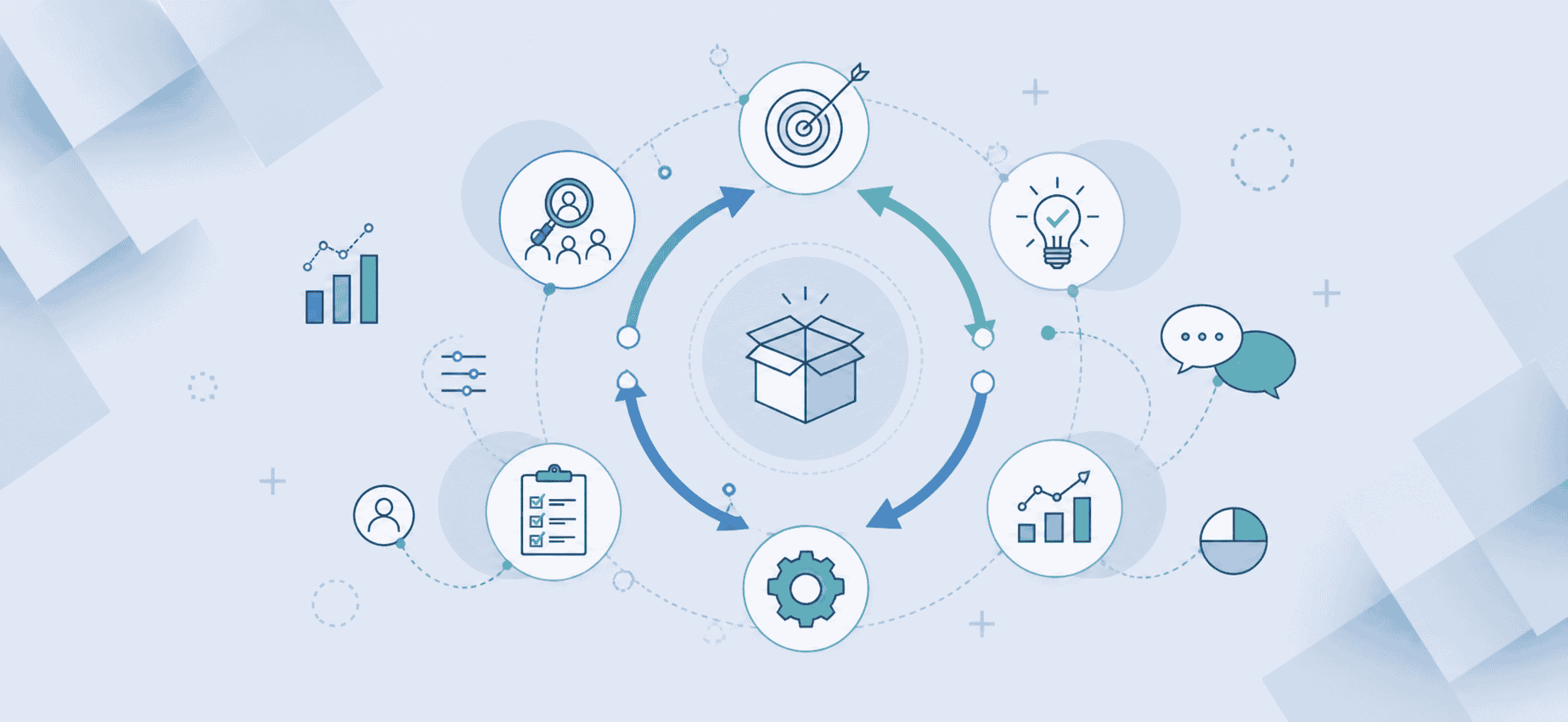
A more practical way to approach lifecycle management is to think in terms of a continuous decision loop rather than a fixed sequence of stages.
At any point in a product’s lifecycle, the same core questions apply:
- Does this product still provide meaningful value to the market?
- Where should investment and resources be focused next?
- Does this product still align with customer and business needs?
- When is it time to shift resources or stop altogether
These questions aren’t tied to a specific phase; they persist throughout the life of the product. As market conditions change, customer needs evolve, and products mature. Strong teams revisit these questions continuously adjusting direction based on real signals rather than assumptions.
In practice, this shifts product lifecycle management from a theoretical model into an operational discipline. Teams stop managing stages and start managing decisions. That often means revalidating problems before committing to new development, focusing investment where it drives real growth, and making proactive decisions about when to scale back or move on.
Moving beyond stages isn’t about abandoning structure altogether, but about replacing static models with a system that reflects how products actually evolve. The idea is to understand that the product lifecycle doesn’t tell you what to do next; your understanding of the market does.