
9 minute read
Product managers have never had more access to market information. Customer interviews, product analytics, competitor announcements, industry reports, sales conversations, economic data, and AI-powered research tools all offer valuable insights into what’s changing around us. The challenge isn’t finding information. It’s figuring out which changes actually matter.
That’s where market trend analysis matters Done well, it helps product teams separate meaningful market shifts from everyday noise so they can make better product decisions with greater confidence. Instead of reacting to every new competitor announcement or emerging technology, product managers can use market evidence to understand what is changing, why it’s changing, and whether it requires action.
Understanding how to analyze market trends begins with understanding what market trend analysis is and, just as importantly, what it isn’t.
Key Takeaways
- Market trend analysis helps product managers make better product decisions by identifying meaningful changes in customers, markets, competitors, and technology.
- Not every market signal requires action. The strongest trends are supported by evidence from multiple sources over time.
- Market evidence should inform product strategy, roadmap prioritization, and investment decisions, not simply describe what’s happening in the market.
- AI can accelerate market research and identify patterns, but product managers remain responsible for interpreting the evidence and deciding how to respond.
What Is Market Trend Analysis for Product Managers?
Market trend analysis is the process of identifying, evaluating, and interpreting meaningful changes in customers, markets, competitors, technology, regulation, and the broader business environment so product teams can make better product decisions. The goal isn’t to predict the future. It’s to better understand what’s changing today and decide whether those changes should influence your product strategy.
Research from the UK Government’s Futures Toolkit and the OECD describes trend and horizon scanning as structured approaches for examining change and supporting better decisions rather than predicting a single outcome. That perspective closely aligns with the role trend analysis plays in product management.
For product managers, this distinction matters. A single customer request, competitor announcement, or industry headline may be interesting, but none of those represent a market trend on its own. Meaningful trends emerge when market evidence builds over time, appears across multiple sources, and has implications for the customers and markets your product serves.
Trend analysis is also broader than competitive analysis. Competitors are one source of market intelligence, but they’re only part of the picture. Customer behavior, economic conditions, regulatory changes, distribution channels, and emerging technologies can all reshape the markets your products serve. Looking at only one source of information makes it difficult to understand what is really changing.
The goal isn’t to collect more data. It’s to gather the right market evidence so you can make better product decisions.
What’s the Difference Between Market Trend Analysis and Competitive Analysis?
Competitive analysis and market trend analysis both support product strategy, but they answer different questions.
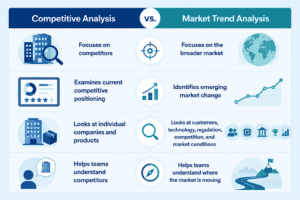
Competitive analysis helps you understand today’s competitive landscape. Market trend analysis helps you recognize broader changes that could influence future product decisions. Product teams need both, but they serve different purposes.
Why Is Market Trend Analysis Important for Product Strategy?
Market trend analysis helps product managers make more informed product strategy, roadmap prioritization, positioning, and investment decisions by providing evidence that customer needs or market conditions are changing.
Instead of reacting to every competitor’s announcement or customer request, product teams can step back, look for patterns, and determine whether the market is actually changing. That context helps inform decisions such as:
- Evaluating whether customer problems are changing
- Identifying emerging market opportunities
- Prioritizing roadmap investments
- Refining positioning and messaging
- Assessing competitive threats
- Determining whether existing products continue to create value
Pragmatic’s guidance on market research reinforces that better decisions don’t come from collecting more information alone. They come from defining clear objectives, gathering relevant evidence, and interpreting what it means for the business. AI can help accelerate analysis, but product professionals remain responsible for deciding how those insights should influence product strategy.
Trend analysis isn’t valuable because it tells you what is happening in the market but because it can help you determine your next steps.
What Market Trends Should Product Managers Monitor?
Although every market is different, most product managers, especially those working in B2B SaaS, benefit from monitoring customer, technology, competitive, regulatory, economic, and industry trends. These categories provide a broad view of the forces that can influence customer needs and product strategy.
Every product operates in a different environment, so the trends that matter will vary. The goal isn’t to track every possible change. It’s to identify the forces most likely to influence your product decisions.
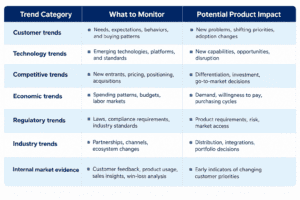
Looking at only one category rarely tells the whole story. The strongest conclusions come from connecting market evidence across multiple sources. When customer interviews, product usage, competitive activity, and market data all point in the same direction, you can have much greater confidence that you’re seeing a meaningful trend rather than an isolated event.
How Can Product Managers Separate Market Noise from Real Trends?
One of the biggest challenges in market trend analysis isn’t finding information. It’s deciding which signals deserve attention. And, one of the most common mistakes product managers make is treating a single customer request or competitor announcement as evidence of a market trend. Individual observations should trigger investigation, not immediate roadmap changes.
Rather than reacting to every new piece of information, pressure-test what you’re seeing before changing direction.
Ask yourself:
Is the change persistent?
One isolated event rarely represents a market trend. Look for evidence that the change continues over time rather than appearing as a temporary spike or reaction to a single event.
Does the evidence come from multiple sources?
The strongest conclusions rarely come from a single customer, report, or analyst. When customer interviews, product usage, sales conversations, and market research all begin pointing in the same direction, confidence increases.
Is it relevant to your market?
A trend making headlines across the industry may have little impact on your customers. Focus on the changes that affect the people your product serves and the problems they’re trying to solve.
Could this influence a product decision?
Not every observation requires action. Ask whether the evidence should influence your roadmap, positioning, pricing, investment decisions, or future research.
Does the evidence challenge your assumptions?
Good market analysis doesn’t simply confirm what you already believe. Actively look for information that contradicts your initial conclusion before deciding you’ve identified a meaningful trend.
Is there enough evidence to act?
Trend analysis rarely provides complete certainty, but it should provide enough confidence to support the next decision. Sometimes that means taking action. Sometimes it means continuing to monitor the market while gathering additional evidence.
Those questions help product teams shift from reacting to information to evaluating market evidence. That’s what turns trend analysis into a practical decision-making discipline.
A Five-Step Process for Conducting Market Trend Analysis
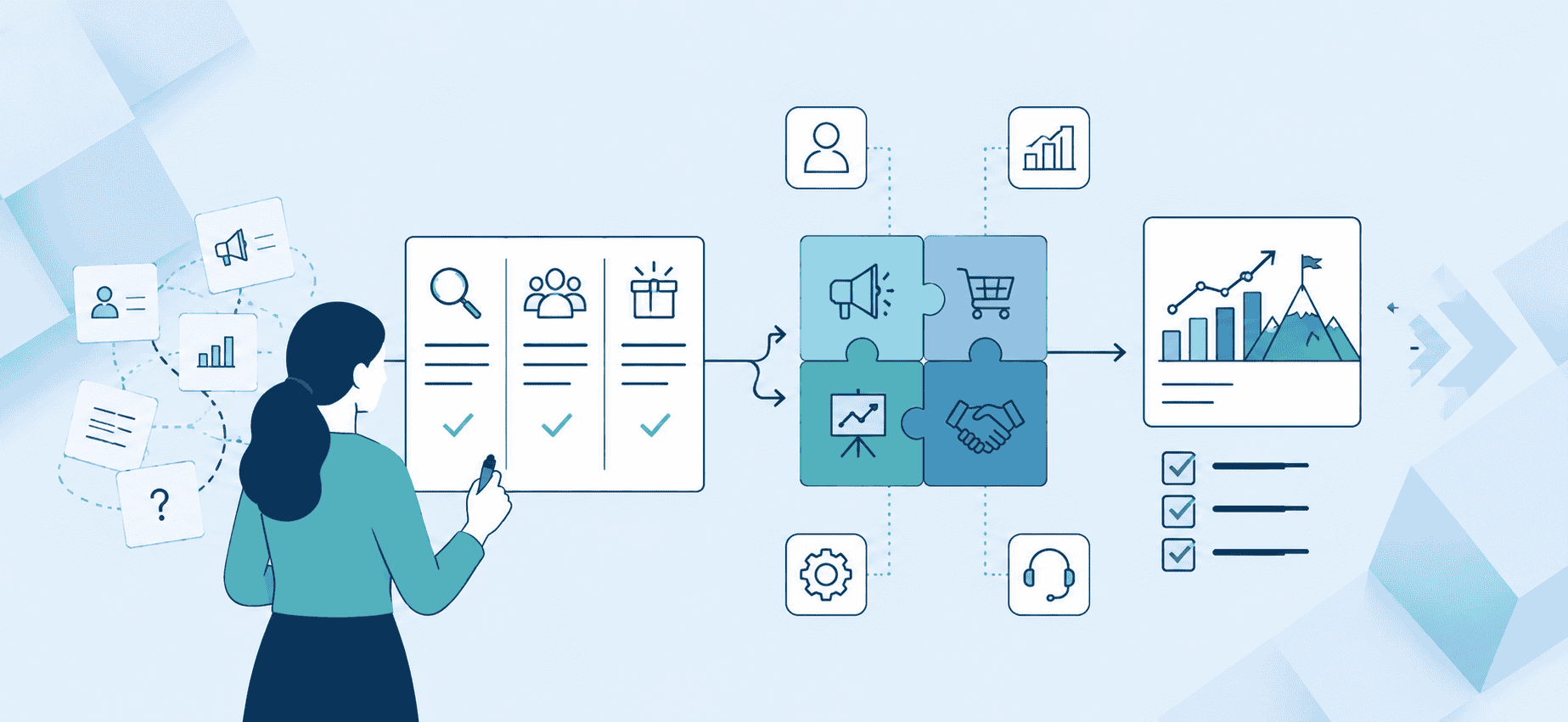
Product teams don’t need a complicated methodology for analyzing market trends, but they do need a process that helps them gather market evidence, evaluate what they’re seeing, and make better product decisions.
1. Start with the Decision
Before gathering market information, define the decision you’re trying to support.
Are you evaluating a new market opportunity? Prioritizing roadmap investments? Exploring a new customer segment? Assessing whether customer needs are changing?
Starting with the decision keeps your research focused. Without a clear objective, it’s easy to collect information that never influences an outcome.
2. Gather Market Evidence
Once you’ve defined the decision, gather evidence from multiple sources.
Start with customer interviews, sales conversations, support interactions, win-loss analysis, and product usage data. These often provide the earliest indication that customer needs or buying behavior are changing.
Then broaden your perspective by incorporating competitor activity, industry publications, government data, regulatory developments, academic research, and market analyses. Digital signals, including search behavior, online communities, and review platforms, can also highlight emerging questions worth investigating.
No single source tells the whole story. The strongest conclusions come from combining multiple perspectives.
3. Look for Patterns
Review the evidence and look beyond individual observations.
Ask yourself:
- What themes appear consistently?
- Which sources reinforce one another?
- What evidence challenges my assumptions?
- Is this affecting our target customers?
- Has this pattern continued over time?
This is where isolated observations begin to form a clearer picture of what is happening in the market.
4. Determine the Product Impact
Not every trend requires action.
The most important question is whether the evidence should influence a product decision.
For example:
- Does this change the problems customers need solved?
- How might this impact our strategy?
- Should we reconsider roadmap priorities?
- Has a new opportunity emerged?
- Does our positioning still fit the market?
- Should we investigate this further before investing?
Trend analysis creates value when it moves product teams from observation to action.
Should This Trend Change Your Product Roadmap?
Before adjusting roadmap priorities, ask:
- Does this change customer needs?
- Does this affect our key differentiators?
- Does it affect our target market?
- Is the evidence supported by multiple credible sources?
- Does it align with our product strategy?
- What is the risk of waiting for additional evidence?
If the answer to most of these questions is no, continue monitoring the trend rather than changing direction immediately.
5. Continue Monitoring
Markets fluctuate, customer expectations evolve, competitors respond, technologies mature, and economic conditions change. This level of change presents a challenge and an opportunity. Rather than treating your conclusions as permanent, continue monitoring the market and refine your understanding as new market evidence becomes available.
The goal isn’t to predict every change. It’s to make today’s decisions using the best evidence available while remaining ready to adapt as the market evolves.
How Can Product Managers Use AI for Market Trend Analysis?
AI has made it easier than ever to process large amounts of market information. It can summarize customer interviews, organize product feedback, identify recurring themes, monitor competitor activity, and analyze large volumes of research in a fraction of the time manual analysis would require.
For product managers, that means spending less time organizing information and more time interpreting it.
AI is particularly effective at helping product teams:
- Summarize customer interviews and support conversations
- Identify recurring themes across feedback sources
- Analyze product reviews and survey responses
- Monitor competitor announcements and industry news
- Compare research across multiple reports
- Surface patterns that deserve further investigation
Used well, AI can significantly reduce the time required to gather and organize market evidence. The key is remembering that identifying patterns isn’t the same as understanding what they mean.
AI can tell you that customers are discussing a particular topic more frequently. It cannot determine whether that shift represents a meaningful market trend, whether it aligns with your product strategy, or whether it justifies changing your roadmap. AI should support product decisions, not make them.
Where AI Falls Short
While AI is becoming an increasingly valuable research assistant, there are several areas where product managers still need to apply experience and judgment.
AI cannot:
- Determine whether a trend aligns with your product strategy
- Understand your organization’s business priorities or constraints
- Replace direct customer conversations
- Evaluate strategic tradeoffs between competing investments
- Decide whether market evidence is strong enough to justify changing direction
Think of AI as an accelerator rather than an authority. It can help you gather, organize, and summarize market evidence, but product managers remain responsible for validating that evidence, interpreting the context, and deciding how the business should respond.
The strongest product teams combine AI’s ability to process information quickly with the critical thinking, customer understanding, and strategic judgment that only experienced product professionals can provide.
Common Mistakes Product Managers Make When Analyzing Market Trends
Even experienced product managers can misinterpret market evidence. Most mistakes happen not because teams lack information, but because they reach conclusions too quickly or rely on incomplete evidence.
Watch for these common pitfalls.
Reacting to a Single Customer Request
Individual requests are valuable, but they rarely represent an entire market. Treat them as signals to investigate rather than immediate justification for changing your roadmap.
Following Competitors Instead of Customers
Competitors can provide useful market intelligence, but they shouldn’t define your product strategy. Focus first on understanding changing customer needs and then determine how your product should respond.
Collecting Information Without a Decision in Mind
Research is most valuable when it supports a specific product decision. Gathering information without a clear objective often leads to interesting observations that never influence action.
Treating AI Output as a Conclusion
AI-generated summaries are a starting point, not the final answer. Always validate important findings against multiple sources before making strategic decisions.
Looking Only for Evidence That Confirms Your Assumptions
It’s easy to notice information that supports your existing beliefs while overlooking evidence that points in another direction. Deliberately look for contradictory evidence before deciding you’ve identified a meaningful market trend.
Avoiding these mistakes won’t eliminate uncertainty, but it will improve the quality of the product decisions you make.
A Checklist for Pressure-Testing Market Evidence
Before changing your roadmap, repositioning a product, or investing in a new opportunity, pressure-test the market evidence you’ve gathered.
Ask yourself:
✓ What product decision are we trying to support?
✓ What market evidence do we have?
✓ Does the evidence come from multiple credible sources?
✓ Is this relevant to our customers and target market?
✓ Are we seeing a sustained pattern or reacting to a single event?
✓ Have we looked for evidence that challenges our assumptions?
✓ Would acting on this trend create more value for customers and the business?
✓ If we waited another month, what additional evidence would we expect to see?
If you can’t answer those questions confidently, you may have identified an interesting signal, but you probably don’t have enough evidence to conclude that you’ve identified a meaningful market trend.
Frequently Asked Questions About Market Trend Analysis
The following are commonly asked questions about market trend analysis.
What is the difference between a market signal and a market trend?
A market signal is an individual observation, such as a customer request, competitor announcement, or emerging technology. A market trend is supported by evidence from multiple sources over time and has the potential to influence product strategy or customer behavior.
When should product managers conduct market trend analysis?
Market trend analysis should be an ongoing activity, but it’s particularly valuable when evaluating roadmap priorities, entering new markets, assessing changing customer needs, considering product investments, or reviewing competitive shifts.
Can AI replace market trend analysis?
No. AI can help product managers gather, organize, and summarize market information, but it cannot determine strategic priorities or decide how a product team should respond. Human judgment remains essential.
What market trends should B2B SaaS product managers monitor?
Most B2B SaaS product managers should monitor customer needs, competitive activity, emerging technologies, regulatory developments, economic conditions, industry changes, and internal market evidence such as customer feedback, product usage data, and win-loss analysis.
Conclusion
Product managers don’t create value by identifying the greatest number of market trends. They create value by recognizing the changes that matter, validating those changes with evidence, and deciding how their products should respond.
Market trend analysis isn’t about predicting the future or reacting to every new headline. It’s about reducing uncertainty so you can make better product decisions with greater confidence. Markets will continue to evolve. Customer expectations will continue to change. New technologies will emerge, competitors will adapt, and fresh opportunities will appear.
The product teams that respond most effectively won’t be the ones collecting the most information. They’ll be the ones asking better questions, gathering stronger market evidence, and using that evidence to make thoughtful, informed decisions.
The next time a new technology, competitor announcement, or customer request captures your attention, don’t start by asking whether it’s the next big trend.
Start with a more useful question: What market evidence do we have, and what product decision should it help us make?