

Managing product teams without clear guidelines or a comprehensive framework is like herding cats. Product teams are made up of people with very different roles. And product managers, developers, designers, and marketers all tend to speak their own languages, make up their own acronyms, and have their own opinions and agendas.
If you want to build a strong, integrated, high-performing team, you need clear objectives, communications, priorities, and an understanding of the roles and responsibilities of each player. It’s often overwhelming. Where do you start? I started by implementing the Pragmatic Institute methodology with one of my product teams and continued using it as my career progressed because it works and delivers results.
I’ve found that building a strong, integrated high-performing product team can be boiled down to four major steps.
- Create a shared future for the team
- Develop a common vocabulary for a stronger community
- Ensure organizational alignment
- Establish clear priorities
So, what do these steps mean and how can you get there?

Shared Future
Unfortunately, many product teams are guided by internal opinions and often end up with a product offering that buyers don’t want. To overcome this, the team has to be guided by a common understanding of what their market actually needs, what specific problem they need solved, who is helped by solving the problem, and what is the unique value of your solution vs. other solutions in the marketplace.
Shared Common Vocabulary
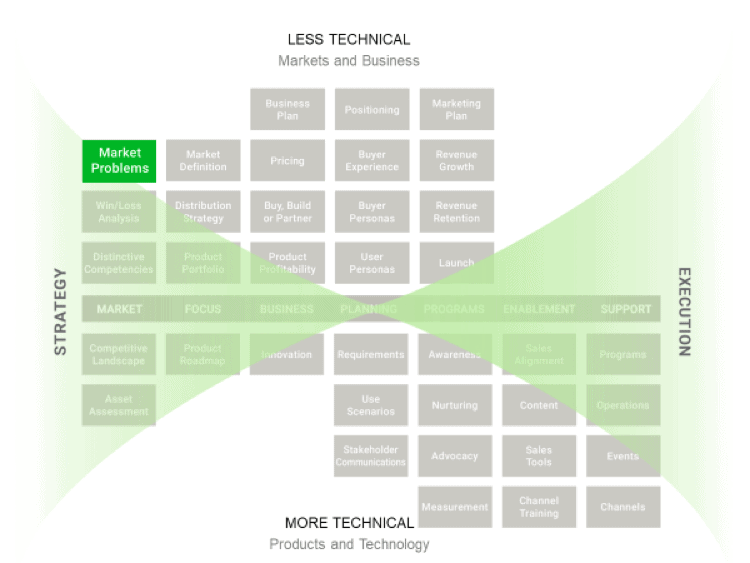
All too frequently, your teams will take on an isolated activity in a vacuum, not understanding interdependencies and realizing its impact on the overall plan. Pragmatic Institute created a proven framework with 37 essential product management and product marketing activities, shown below. As you can see, some of the activities are more strategic or tactical, some more business/market or product/technology-oriented. But, regardless of the type of activity, it’s vital to complete each one and hand it off to successfully manage and market technology products. While the framework provides a blueprint for all of the necessary product management and marketing activities, it’s also a reference guide that gives your teams a common understanding of the plan for taking a product to market.
Organizational Alignment
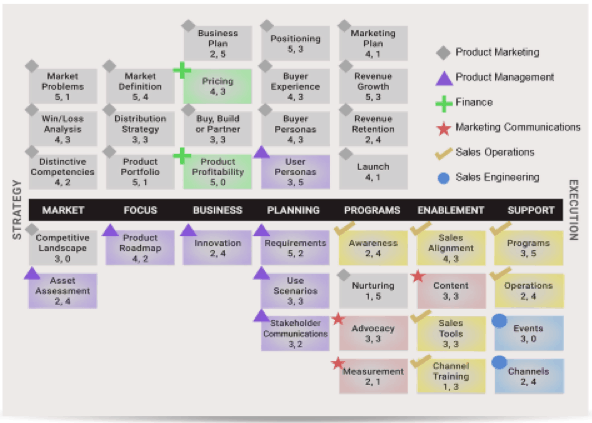
Regardless of how your company or organization is organized, you need to evaluate the amount of work each activity requires and allocate the right number of functional resources to get it done, and clearly assign who will do what). As shown in the example below, the Pragmatic Institute Framework can help you accomplish this.
Prioritization
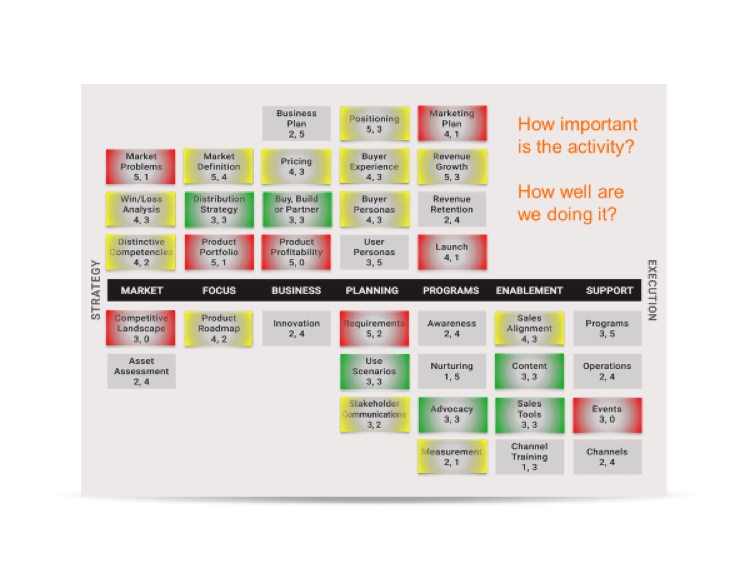
The last step to maximize team performance is classifying the importance of each activity and ascertaining how well your team is doing it. Categorizing and ranking each activity enables you to easily identify resource gaps as well as areas that are over-resourced. With the Pragmatic Institute Framework, you can develop a heat map.
Is it worth this effort? One of our customers, Wolters Kluwer, has realized a more than 50% reduction in time to market since taking Pragmatic Institute training according to Brian Diaz, Director of Product. Another, a Business Director for a Fortune 500 Aerospace & Defense Company, says “Pragmatic Institute training has ensured that we stay laser-focused on customer problems. We only build solutions to the problems that are urgent, pervasive, and which our customers are willing to pay for.”
So, yes, it is well worth the effort.