

I hear this question almost every week: Is product management going away? The future of product management will look different, but I do not believe the function is disappearing.
Companies will continue to develop and launch products that create value. Someone still has to understand the market, decide which problems deserve investment, and bring the right work to market, even when AI assists with much of the process. Team size and skill requirements may change considerably, but the responsibility remains.
The more immediate issue is that the boundaries around product roles are becoming less clear.
AI is expanding the product manager’s role
Product managers have traditionally worked alongside specialists in user experience, data, and engineering. As AI makes parts of those disciplines more accessible, product managers are being asked to take on work that once sat with someone else. They may conduct more research, explore data independently, or build an early prototype before involving a larger team.
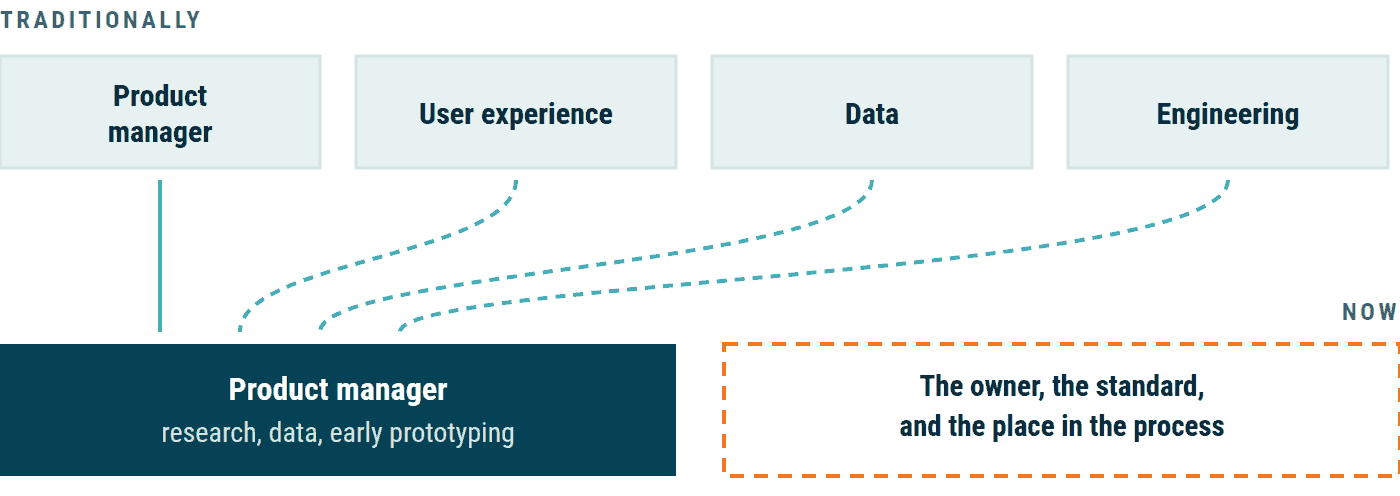
This is often framed as a question of individual development, but leaders also need to consider how the organization will support the shift.
A discipline has an owner, a standard, and a defined place in the process when it belongs to a specific role. Once that work moves into a role that is already full, the standard can disappear. Research gets done by whoever has time, prioritization becomes a debate, and teams in the same company reach different answers because they are working from different definitions of good product practice.
Role clarity is becoming an investment decision
Many product leaders already see the product role defined differently from one business unit to the next. AI can accelerate that drift unless leadership is explicit about responsibilities, decision rights, and the capabilities every team should share.
Individual courses can help someone improve, but they rarely create consistency across an organization on their own. The learning has to reach the colleagues who make decisions together, often across more than one product team, if it is going to change how the work gets done.
Technology alone does not improve product outcomes.
From the announcement of Danielle Chircop as Chief Executive Officer, July 2026
Most organizations that ask us about AI already have tools and talented people. The harder question is how they will decide which opportunities are worth pursuing and apply the same standard across teams.
Where Pragmatic can help
Pragmatic should not promise to turn every product manager into a user experience expert, data scientist, and engineer. That would set an unrealistic expectation for both the individual and the organization.
Our focus is the judgment behind what gets built. As research and analysis move closer to the product manager, teams need a disciplined way to understand the market, validate a problem, and explain why one opportunity deserves investment over another. Market evidence provides that discipline.
This has always been central to the Pragmatic Framework. Product management in the age of AI makes it even more important.
What organization-wide learning can change
Equifax trained product management and product marketing employees together across six courses. Both functions learned the same framework and terminology, and the company later reported stronger alignment. McKesson put its entire product management team through three courses and reported clearer roles and greater confidence in the roadmap.
In both cases, the investment was in a consistent approach to product decisions across the group, not simply in developing a few individuals.
If you are the one funding this
Product capability can be harder to fund than a tool because the expected return is better decision-making rather than a new feature. A clear measurement plan makes the budget conversation more concrete.
- Name the decisions you want to improve. Identify which work reaches the roadmap, what should be stopped, and what evidence teams should use.
- Set a baseline before training begins. Launch timing, the share of roadmap items tied to validated market problems, and rework after release are useful starting points.
- Include the people who make decisions together. A common standard works only when colleagues use it in the same meetings and processes.
- Measure again after two quarters. Review the operating metrics and ask teams what changed. Equifax and McKesson both used follow-up surveys to assess the effect of training.
Where to start
If you are still defining the need, the 10-minute assessment maps your team against the Pragmatic Framework and identifies capability gaps you can bring into a planning or funding conversation.
If the priority is already clear, compare the training options to see which approach fits the number of people involved, the support required, and your budget.
