
In product management, the user journey is the path a user takes while interacting with your product (sometimes called a flow funnel). There are several reasons why a user journey is important in product management.
Perhaps most importantly, understanding your user’s journey can help you identify where there may be gaps or areas for improvement in your product. By identifying these problem areas and determining how to address them, you can improve the overall experience for your users and increase user engagement and retention.
Additionally, understanding the user journey can help you develop more effective marketing and growth strategies, as well as target specific users or segments of your audience that are most likely to benefit from using your product.
Ultimately, by tailoring your product and marketing efforts to meet the needs of your users along each stage of the user journey, you can create a more successful and profitable product that meets their needs and delivers real value.
This article is based on a recent Product Chat featuring Anand Arivukkarasu, Product Leader (formerly of FB) >> Watch his presentation.
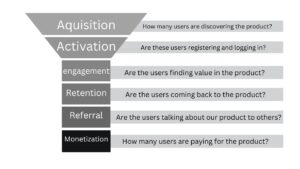
Stage 1: Acquisition
Acquisition is the process of attracting new users to a product or service, and it is an essential part of the user journey. For users to fully engage with a product or service, they must be able to find and access it easily.
Ultimately, successful acquisition involves understanding what motivates potential users and designing targeted strategies that will appeal to them.
In this stage, you should measure the following:
1. Time-to-activation—this will give you an idea of how quickly users can start using your product.
2. The number of users visiting from different channels
3. The cost of inbound traffic
Stage 2: Activation
Activation is the process of registering and logging in to a product or service.
In this stage, you should measure the following:
4. The number of users who sign up, create a profile, etc.
5. User conversion rate
6. Customer acquisition cost (CAC)
7. Monthly Active Users (MAU)
8. Daily Active Users (DAU)
Monthly active users and daily active users are included in activation instead of engagement because active means they come to your product and spend time using it but do not necessarily find the value that leads to engagement.
What’s the difference between the cost of inbound traffic and the cost of acquisition (CAC)?
These two metrics may seem similar at first, and while they are related to each other, they are different. Here is a quick example to demonstrate the difference. If you spend $1,000 to get 1,000 users to your product, the cost of inbound traffic is $1. However, not all 1,000 will activate. Let’s say 200 of those users register or log in to your product, the CAC would be $5.
Stage 3: Engagement
Engagement is where you understand whether the users are finding value in the product and how much value they can extract from your product.
It is important because it can provide valuable insights into user behaviors, preferences, and motivations. Factors that can influence engagement include the ease of use and functionality of the product, as well as the level of support and value provided by the company behind it. By understanding engagement levels, companies can make better decisions about how to improve their products and services to meet user needs better.
In this stage, you should measure the following:
9. Length of engagement (time spent using product)
10. Depth of engagement (likes, comments, etc.)
11. Frequency of engagement (number of sessions per day or week)
12. Weekly engagement users over total weekly active users
Stage 4: Retention
Retention refers to the ongoing engagement that users have with a product or service. It is important because it helps to ensure that users continue to derive value from your product, which reduces the risk of them churning and leaving.
Several strategies can be used to promote retention in a product, such as providing value through new features, optimizing the user experience and fostering engagement through social interactions and community building.
In this stage, you should measure the following:
13. Stickiness ratio (DAU/MAU)
14. The number of users who come back within a 7-day period (L7)
15. The number of users who come back within a 28-day period (L28)
16. The number of users who come back three times in one week (3Dw)
17. User churn rate
Stage 5: Referral
In the referral stage, users are satisfied with your product so they’ll recommend it to others. This matters because it creates positive word-of-mouth marketing for your product, helping to drive additional traffic and engagement from potential new users.
To successfully reach this stage, it is important to focus on building a high-quality product that meets the needs of your target audience, as well as providing excellent customer support at every step of the user journey.
In this stage, you should measure the following:
18. Number of shares/public posts
19. Referral code-based registration
Stage 6: Monetization
This last stage of the user journey is about generating revenue from your users.
In this stage, you should measure the following:
20. The average revenue per user (ARPU)
21. Monthly recurring revenue (MRR)
22. Annual recurring revenue (ARR)
23. User lifetime value (LTV)
Level-Up Your Data Skills
Are you looking to improve your product strategies and decisions with data?
Pragmatic Institute’s Insight course teaches you how to identify patterns in your data to uncover problems and gives you a repeatable process for successful data projects. Whether you want to strengthen your roadmaps, go-to-market plans, or presentations, this course can help you incorporate data effectively and achieve better results.
Sign up for the Insight course today!